What Happened to Media Coverage of Fukushima? (Anne Landman)

Nebraska's Ft. Calhoun nuclear plant, surrounded by floodwaters (Nati Harnik/AP)
June 23, 2011 -- (PRWatch) -- While the U.S. media has been occupied with Anthony Weiner, the Republican presidential candidates and Bristol Palin's memoir, coverage of Japan's Fukushima Daiichi nuclear power plant disaster has practially fallen off the map.
Poor mainstream media coverage of Japan's now months-long struggle to gain control over the Fukushima disaster has deprived Americans of crucial information about the risks of nuclear power following natural disasters. After a few weeks of covering the early aftermath of Japan's earthquake and tsunami, the U.S. media moved on, leaving behind the crisis at Fukushima which continues to unfold.
U.S. politicians, like Rep. Joe Barton of Texas, have madedisappointing and misleading statements about the relative safety of nuclear power and have vowed to stick by our nuclear program, while other countries, like Germany and Italy, have taken serious steps to address the obvious risks of nuclear power -- risks that the Fukushima disaster made painfully evident, at least to the rest of the world.
Problems Multiply
News outlets in other countries have been paying attention to Fukushima, though, and a relative few in this country have as well. A June 16, 2011 Al Jazeera English article titled, Nebraska's Cooper Nuclear plant, amid floodwaters (Photo: Journal Star)Tensions are also rising over two U.S. nuclear reactors in Nebraska located on the banks of the Missouri River, which is now at flood stage.
On June 20, the Omaha, Nebraska World Herald reported that flood waters from the Missouri River came within 18 inches of forcing the Cooper Nuclear Station near Brownville, Nebraska, to shut down. Officials are poised to shut down the Cooper plant when river reaches a level of 902 feet above sea level. The plant is 903 feet above sea level. The Fort Calhoun Nuclear Plant, 20 miles north of Omaha, issued a "Notification of Unusual Event" to the Nuclear Regulatory Commission on June 6 due to local flooding. That plant is currently shut down for refueling, but will not restart because of the flooding.
Compounding worries over these two plants is a shortage of sand needed to fill massive numbers of sandbags to hold off Missouri River floodwaters. One ton of sand makes just 60 sandbags, and hundreds of thousands of sandbags are needed to help save towns along the river from flooding. Sand is obtained from dredging the riverbed -- and the companies that sell sand can't dredge the river while it is flooding. These plants are already in a risky situation, and the flooding in Nebraska could easily be worsened just by a summer afternoon cloudburst.
Global Support for Nuclear Power Drops; Some U.S. Reactors on Borrowed Time
Polls reveal that global support for nuclear power has nosedived in the wake of the Fukushima disaster. A survey of over 19,000 people in 24 countries showed that three quarters of people now think nuclear power will soon be obsolete. Three countries still show support for nuclear power: the United States, India and Poland.
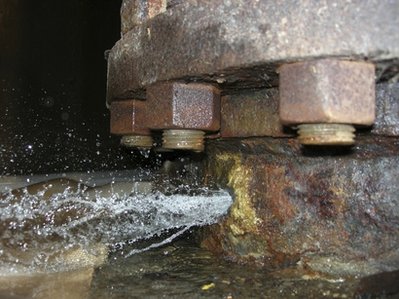
10 gal/minute leak in rusted pipe at a Byron, IL nuclear plant. The pipe carries water to cool the reactor in an emergency (AP)
The relative safety of nuclear power in the U.S. is tenuous, despite what some politicians have claimed. A big problem is that the Nuclear Regulatory Commission (NRC) has been working with the nuclear power industry to keep our country's reactors operating within safety standards, but they've been doing it by either weakening those standards, or not enforcing them at all.
A year-long investigation by the Associated Press (AP) revealed that the NRC has acted appallingly, extending licenses for dozens of aging U.S. nuclear plants despite their having multiple problems, like rusted pipes, broken seals, failed cables and leaking valves. When such problems are found, the NRC will weaken the standards to help the plants meet them instead of ordering them to be repaired to meet current standards.
The nuclear industry argues that the standards they are violating are "unnecessarily conservative," and in response, the NRC simply loosens the standards. Just last year, for example, the NRC weakened the safety margin for acceptable radiation damage to nuclear reactor vessels -- for the second time.
Through public record requests to the NRC, the AP obtained photographs of badly rusted valves, holes eaten into the tops of reactor vessels, severe rust in pipes carrying essential water supplies, peeling walls, actively leaking water pipes and other problems found among the nation's fleet of aging nuclear reactors.
The Take Away
Fukushima has been a wake up call about the dangers of nuclear power, and some countries are heeding the information. But it seems the U.S. is still sleeping when it comes to this issue. Light-to-absent coverage of TEPCO's struggles to bring Fukushima under control, legislators who insist on acting favorably towards the nuclear power industry despite the deteriorated state of our current reactor fleet and an ineffective Nuclear Regulatory Commission have all contributed to a bad combination of a dangerous situation and a complacent American public on this issue.
Maybe now that the latest scandal in Washington has subsided, public and media attention will return to this crucial issue, and the United States will turn its attention to tackling some of the truly serious problems posed by a continuing reliance on nuclear power.
- Categories
- Date rangeSaturday, June 25, 2011
